
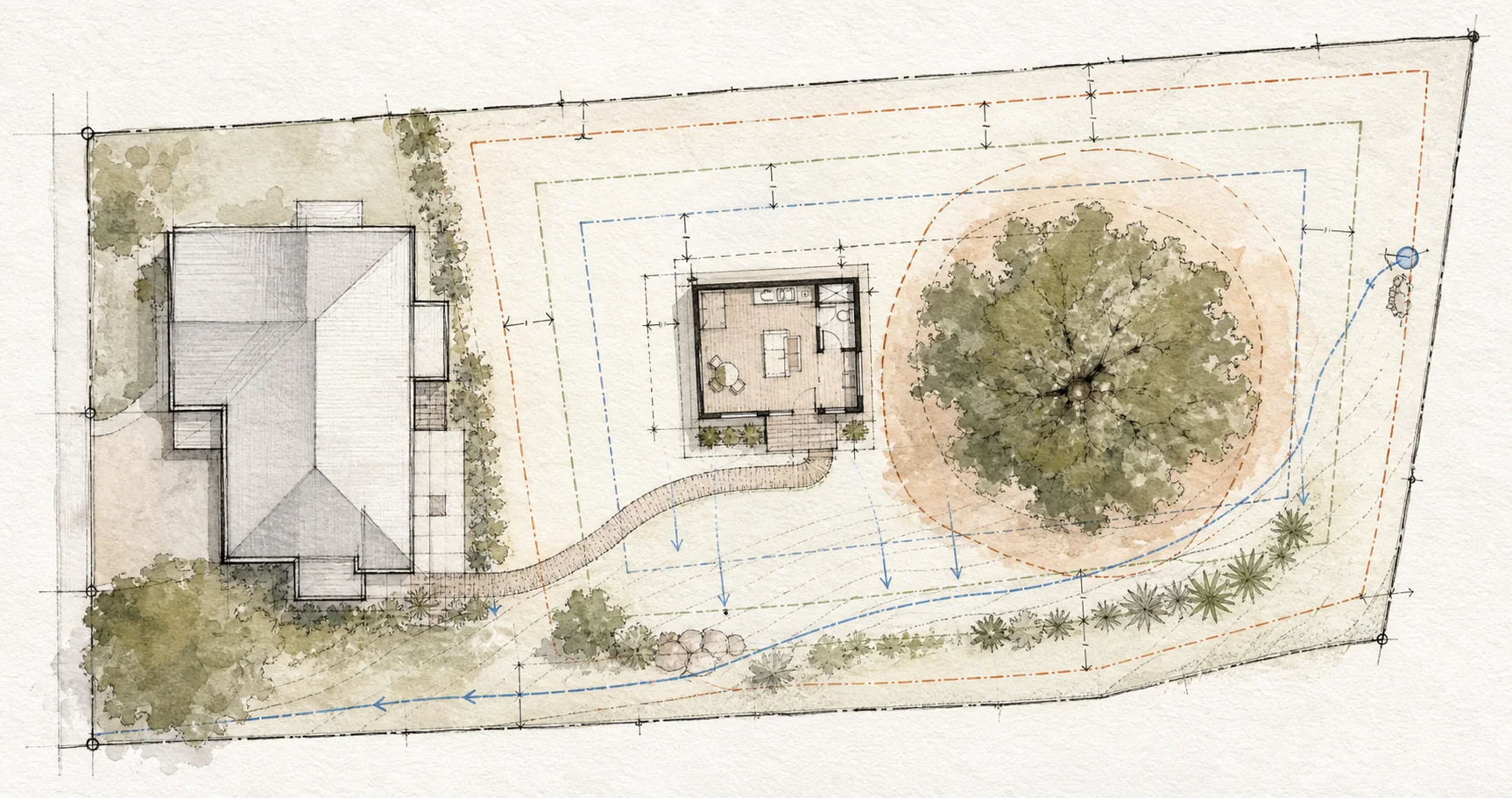
A four-foot setback does not tell you where a Walnut Creek detached ADU should go. The useful sequence is: confirm City jurisdiction, classify the ADU, read the tree rule and ADU exemption together, then test the footprint against the real site.
That sequence prevents two opposite mistakes—assuming every mature tree blocks an ADU, or assuming an ADU exemption removes every site and safety review.
Confirm the permitting jurisdiction first
Use the parcel, not the mailing address. Some properties with a Walnut Creek address are outside the incorporated City and follow Contra Costa County rules instead.
Confirm the assessor parcel number and jurisdiction before relying on a City webpage or paying for a permit set. This is the smallest check in the process and the most expensive one to skip.
If the property is outside Walnut Creek, stop applying the standards below and find the actual permitting agency. Our Walnut Creek ADU permit guide keeps its fee and process research tied to the incorporated City; one jurisdiction's permit process should not be substituted for another's.
Classify the ADU before applying the numbers
Walnut Creek's ADU and JADU guidance distinguishes state-exempt and non-exempt ADUs. For a single-family property, a listed state-exempt type is a new detached ADU that is no more than 800 square feet and is at least four feet from the interior side, corner-side, and rear lot lines.
The same City guidance gives a 16-foot baseline height for that detached state-exempt unit, with a higher transit-related allowance under stated conditions. Confirm eligibility from the actual parcel rather than measuring straight-line distance to a station on a consumer map.
These standards create a zoning envelope; they do not guarantee that every point inside the envelope is buildable. Easements, utilities, drainage, fire access, building separation, grading, and foundation conditions can still move the footprint.
Read the tree permit rule and ADU exemption together
The City's general Tree Removal Permit guidance uses a nine-inch trunk-diameter threshold, measured 4.5 feet above grade, for its private-tree removal process.
Read that page together with Walnut Creek Municipal Code Article 5. Section 10-2.3.504 says the specified state-exempt ADU categories are exempt from property-development regulations elsewhere in the zoning chapter and from the private-property tree-preservation chapter.
The careful conclusion is narrower than either rule by itself:
- the tree page describes the City's general tree-removal process;
- the ADU code identifies which ADU categories receive stated local exemptions; and
- neither page turns an unverified sketch into permission to remove a tree or start construction.
Public trees, work in the right-of-way, grading, utilities, fire access, and other separate approvals may follow different rules. When the proposed foundation or access route affects a mature tree, send the City a dimensioned site plan and ask for a project-specific determination.
Map the tree before fixing the floor plan
Put the trunk, approximate canopy, visible grade changes, drainage, utilities, easements, and access on the same site drawing as the proposed ADU. A survey or arborist input may be appropriate when the footprint is close to a property line or tree, but the need is site-specific.
This turns the design question from “Can an 800-square-foot box fit?” into better questions:
- Where can the foundation go without relying on an assumed property line?
- Can construction equipment reach the site without damaging the tree or neighboring property?
- Do utility trenches cross the same root area the building avoids?
- Can the unit meet fire, sanitary, drainage, and building-separation requirements?
Moving a footprint during feasibility is usually simpler than redesigning foundations, utilities, windows, and energy documents after plan check.
A pre-reviewed plan still needs a site review
Walnut Creek's Pre-Reviewed ADU Plans page currently says its PRADU plans are unavailable while they are updated for the 2025 Building Code. Check the page again before choosing this path because that status can change.
When available, the City says the plans cannot be revised, although they may be oriented, mirrored, or flipped. The applicant still supplies a valid site plan, obtains construction permits and outside-agency approvals, pays applicable fees, completes inspections, and obtains a certificate of occupancy.
In other words, pre-review can shorten review of the repeatable building design. It does not pre-approve your lot, easements, tree relationship, utilities, foundation conditions, or agency clearances.
Plan for permits and fees as separate questions
The process question is “What approvals and documents does this parcel need?” The fee question is “What will each reviewing agency charge for this defined project?” Answer them separately.
Walnut Creek's ADU page tells applicants to check water, sanitary, and other utility districts for connection fees. The PRADU page also notes that fire, sanitary, school, and other conditions may apply. A building-department estimate alone can therefore miss charges controlled by another agency.
Use our permit fee methodology to see how we separate published schedules from working estimates. You can also start with the cities we currently cover; if Walnut Creek is not listed, that means we have not published a city fee model yet—not that the project has no fees.
Pre-design checklist
- Confirm that the parcel is inside incorporated Walnut Creek.
- Identify the exact ADU category before using size, height, or setback rules.
- Draw property lines, easements, buildings, utilities, drainage, and access.
- Locate mature trees and measure any trunk relevant to the study area.
- Test foundations and utility trenches, not just the walls, against site constraints.
- Ask the City to resolve any uncertainty about the ADU exemption and separate permits.
- Check fire, sanitary, water, school, and other outside-agency requirements.
- Recheck PRADU availability and the currently adopted building code.
Common questions
Does a mature tree automatically prevent a detached ADU?
No. The answer depends on the ADU category, the City's stated exemption, ownership of the tree, and any separate site or safety approvals. Get a parcel-specific determination before planning removal.
Does ministerial review mean no permit review?
No. It means the City applies objective standards without a discretionary hearing when the statutory conditions are met. The application still needs a complete, code-compliant permit set and any required outside-agency approvals.
Can a PRADU plan be placed anywhere on the lot?
No. A pre-reviewed building plan still needs a valid site plan and must work with the parcel's setbacks, easements, slope, utilities, access, and other conditions.
For budgeting, read how to interpret an ADU permit fee report before treating any range as a City quote.